LED and Illuminated Monument Signs
Half the hours in a year are dark, and in December the sun is down before most people leave work. A sign that cannot be read after dark is only doing half its job. There are four common ways to fix that, and they cost and look very different.
The simplest is ground lighting: floodlights set in the bed and aimed up at the face. Next is an internally lit cabinet, where LED modules sit inside a box behind a translucent face. Then there are halo-lit and push-through letters, which put the light into the lettering itself. And at the top end is a full-color LED message center, which is a screen you program.
Full-color LED message centers
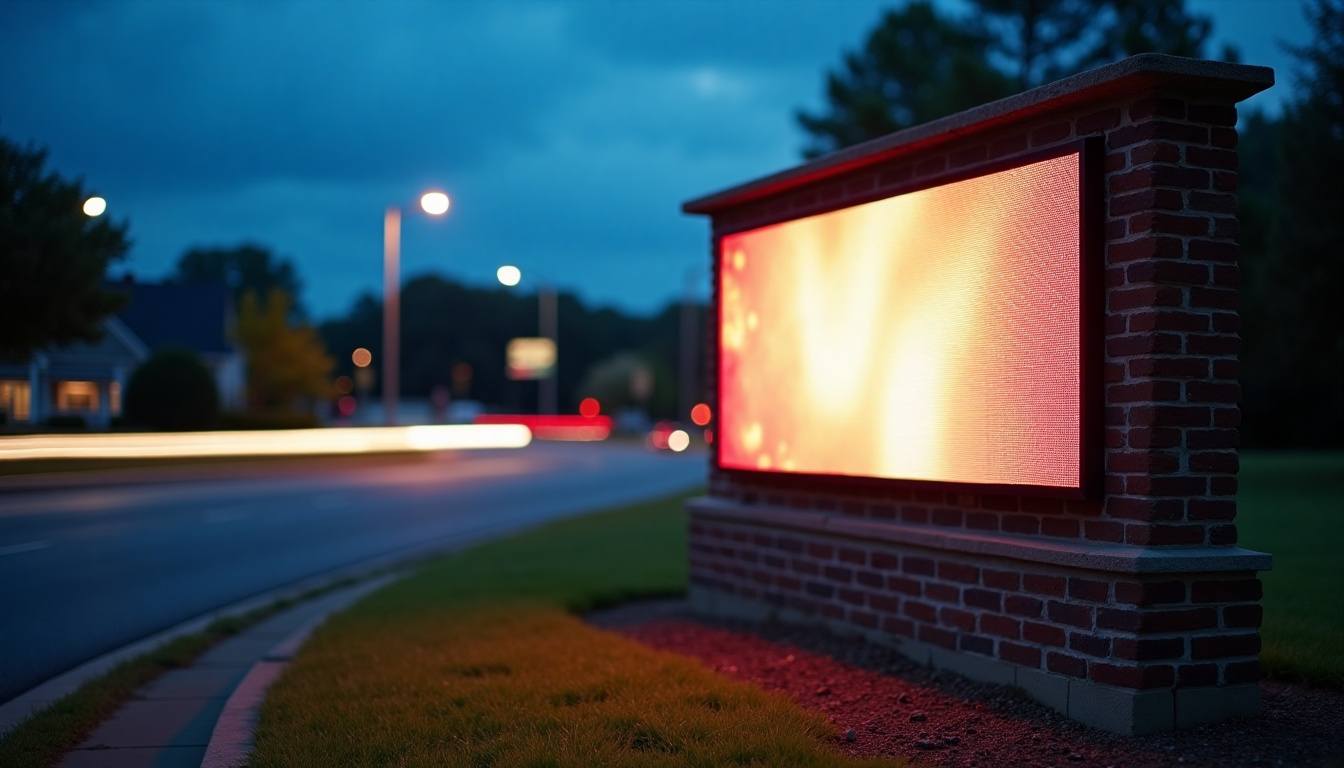
An electronic message center is a weatherproof LED display built into the sign. It can show text, photos, logos and short animations, and you change it from a computer or phone. Businesses use it for sales and hours, car lots for inventory, churches and schools for the week's events.
The main choices are size, pixel pitch and color. Pixel pitch is the spacing between LEDs; a tighter pitch looks sharper up close and costs more, while a sign read from a fast road can use a wider pitch. Single-color amber boards cost less and are fine for text. We size the board to the distance and speed of the people reading it, then build the cabinet into a brick, stone or aluminum base so it looks like a monument sign and not a screen on a pole. For churches, there is more on message boards for congregations.
Halo-lit and push-through letters
Halo-lit letters are solid metal letters standing off a wall, lit from behind so the light washes out around each letter. At night the name sits in a soft glow; during the day the letters read as clean dimensional metal. They suit offices, medical practices and any brand that wants a quieter look.
Push-through letters are cut out of an aluminum face, with acrylic letters pushed through the openings and lit from inside the cabinet. Only the letters glow and the face stays dark. It is a sharp, high-end look for a lit cabinet and easier to read at a distance than halo lighting.
Power, timers and dimming
Every lit sign needs power at the sign, and getting it there is often the biggest variable in the job. If there is already a circuit at the old sign, we use it. If not, power has to be trenched from the building or a nearby panel, and that run gets planned before the footing goes in so conduit is set in the concrete.
Lighting goes on a photocell, a timer or both, so it comes on at dusk and goes off when the business closes or late at night. Message centers carry an ambient light sensor and dim themselves after sunset. A board running at daytime brightness at midnight is hard on drivers, hard on the neighbors and usually against the rules. We set the schedule with you at install and show whoever runs the sign how to change it when hours shift for the holidays.
Brightness and message rules in the city
Electronic signs have more rules than plain ones. Ordinances in Greensboro, High Point and the surrounding towns generally address night brightness, how long a message has to stay up before it changes, and whether it can scroll or flash. Some zoning districts limit electronic messages more than others.
We look up the rules for your address before we spec the board and set the timing and dimming to match. The permit drawings show the display size and settings, and we file them for you. If you are out east in Alamance County, the process for projects east toward Burlington runs through that city instead.
Thunderstorms, surges and keeping it lit
The Triad summer brings strong afternoon thunderstorms, and lightning is the main thing that kills lit signs here. A strike nearby sends a surge down the power line that can take out a power supply or a message board's controller in one hit. Ice storms bring outages and hard restarts.
We put surge protection on every lit sign and ground the cabinet properly. We seal the cabinet against the humidity that fogs faces and corrodes connections, and we use LED modules and power supplies rated for outdoor use. Sealed, grounded and protected signs come through storm season with a lot fewer service calls.
Running costs and service life
LED lighting draws far less power than the fluorescent tubes in older cabinets, and it lasts many years longer. Swapping an old fluorescent cabinet to LED modules is one of the most common jobs we do, and it usually pays for itself in bulbs and service calls alone.
Message centers use more power than a lit cabinet, but automatic dimming cuts that at night. With good surge protection and a sealed cabinet, a quality board runs for many years. Every sign is quoted by size, materials and lighting, with a drawing and the price in writing before any digging starts, and for a lit sign that includes the power run, so the number you see is the full number.
Price a lit sign
Send the form with the address and a note on what kind of lighting you want, or just tell us you are not sure yet, and email a photo of the spot to jedsigns101@gmail.com. Let us know if there is power at the location now. The shop is open Monday through Thursday from 8 AM to 5 PM and Friday from 8 AM to noon, closed on weekends, and we can come look at an existing sign at dusk if you want to see how it reads after dark.
Mon–Thu 8 AM–5 PM · Fri 8 AM–12 PM · Sat–Sun closed